Visualizing the Invisible: How DoseRT is Redefining Safety at Shrewsbury and Telford
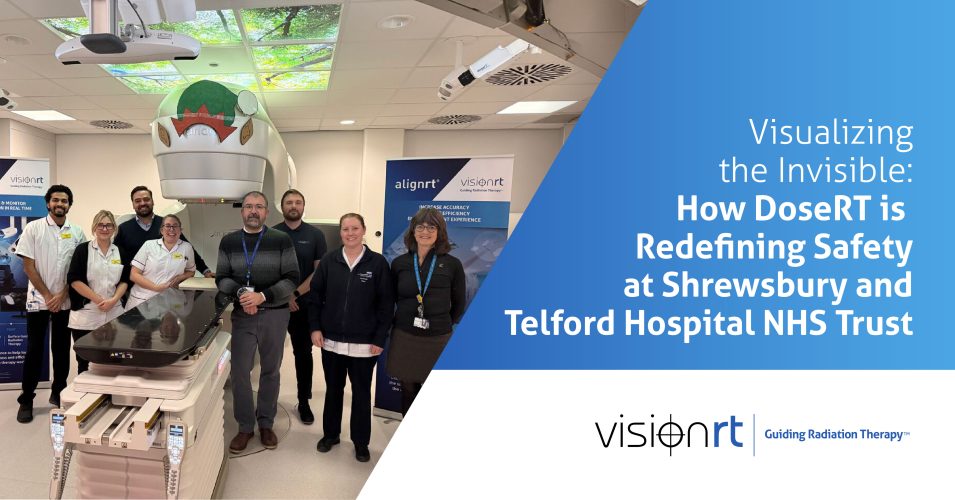
At Shrewsbury and Telford Hospital NHS Trust, precision is the cornerstone of care for the 1,700 radiotherapy patients treated annually. However, even with advanced imaging, a fundamental question often remained: how can we verify the beam’s interaction with the patient in real time? To bridge this gap, the Trust introduced DoseRT for real-time dose visualization. As Dr Rick Sims, Head of Radiotherapy Physics explains, the goal was clear: “Increasing confidence that the planned dose matches what is delivered, detecting setup variations or anomalies early, confirming organ-at-risk (OAR) sparing, and identifying opportunities for workflow or positioning improvements — all without adding significant time to treatment.”
In November 2025, the hospital became the first UK centre to implement the Cherenkov imaging solution. Now, five months into clinical use and with over 2,000 treatment fractions captured, the technology is providing a transformative safety net, offering what Dr Sims describes as “the missing piece” of the radiotherapy puzzle.
Seamless Integration into Clinical Workflow
The rollout of DoseRT was both structured and collaborative, enabling rapid integration into clinical workflows. “The installation and acceptance testing went smoothly. A dedicated local team and structured feedback loops helped refine processes and ensure effective adoption,” says Dr Sims.
From a clinical perspective, DoseRT has been embedded as an additional safeguard within existing verification processes. It now serves as “an additional layer of qualitative in-vivo verification,” complementing established imaging and positioning systems. Radiographers are encouraged to flag any unexpected findings, which are then reviewed by a dedicated team to provide guidance and ensure appropriate follow-up.
Importantly, this added layer of insight does not come at the cost of efficiency. “The imaging itself adds no extra time during delivery,” Georgina Glennon, Lead Radiographer for DoseRT, notes, reinforcing how the technology can enhance radiotherapy workflows while maintaining throughput and treatment accuracy.
Revealing the Subtle Details That Matter
One of the most notable early findings from clinical use of DoseRT has been its ability to reveal subtle variations in dose delivery that are otherwise difficult to detect. As Dr Sims explains, “the most pleasant surprise was how clearly it visualises subtle variations, such as ‘cold strips’ between fields, daily pitch/roll changes, or minor setup errors, that are within AlignRT tolerances but still affect dose delivery.”
Beyond these refinements in setup accuracy, the system has also provided important reassurance in clinically critical areas. “We also saw very clear confirmation of OAR sparing for head and neck and breast cases,” Dr Sims notes, alongside the identification of “unexpected ‘dose splash’ areas that prompted simple interventions like chin lifting.” In one example, “the Cherenkov image highlighted higher-than-expected signal in the chin region”. A simple positional change, asking the patient to slightly adjust their chin, “reduced the signal to normal tissue while maintaining target coverage.” In another case, “we identified a stoma bag positioned in the field, which prompted a plan review and reinforced the value of final checks.”
As Dr Sims summarises, the value extends beyond individual cases: “an awareness of how much the patient’s moving around and also those small dose errors that you don’t necessarily catch with all the other technologies.”
To support ongoing learning, the Trust has developed structured processes for reviewing DoseRT images. This includes dedicated offline analysis of cumulative dose maps, helping the team build a clearer understanding of expected versus unexpected patterns. Over time, this has strengthened the department’s safety culture and highlighted previously unseen opportunities for positioning refinement and treatment optimisation.
The Future of Cherenkov Imaging in Radiotherapy
Reflecting on the broader clinical impact of DoseRT, Dr Sims describes the technology as “the missing piece — real-time visualisation of the actual radiation dose being delivered on the patient’s skin.” He adds, “I look at it in awe. I’m just amazed that you can see the dose being delivered on the patient,” highlighting the significance of moving from inferred to directly visualised dose delivery.
Looking ahead, the team at Shrewsbury and Telford Hospital NHS Trust sees strong potential for DoseRT and Cherenkov imaging to become embedded within routine high-precision radiotherapy workflows. “We see it becoming a standard part of high precision radiotherapy workflows,” Dr Sims notes, reflecting a growing view that real-time dose visualisation could play an increasingly central role in treatment verification and quality assurance.
More broadly, the early experience at the Trust demonstrates how real-time dose visualisation can bring radiotherapy closer to true treatment verification. By bridging the gap between planned and delivered dose, technologies such as DoseRT have the potential to enhance clinical confidence, support continuous learning, and ultimately contribute to safer, more precise patient care.
Get in touch
Ready to take the next step?
Vision RT’s family of SGRT solutions guide radiation therapy for better patient care at every step: Sim, Planning, Treatment and Dose. Whether you’re looking for a quote, a product demo (virtual or in-person) or just more information, please get in touch.