Consistency and Automation for your AlignRT Patient Prep
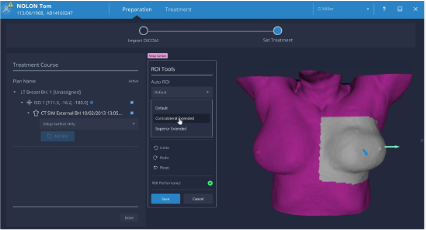
Defining the right area to monitor on each patient is a critical step for successful motion management.
Previously, drawing a Region of Interest (ROI) was done manually, using an array of tools within AlignRT. Ensuring uniform best practice across all users has been key to repeatability, and requires clinical resources and attention.
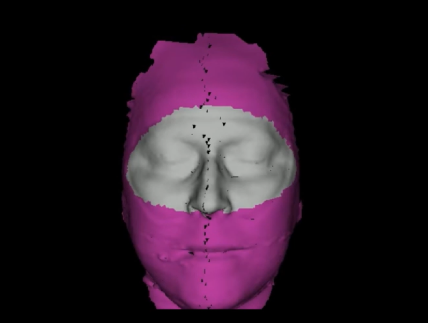
Now with AlignRT’s new Auto ROI™ module, regions of interest (ROI) for the most common body sites are defined automatically.

Automating ROI definition is intended to save clinics time in patient preparation, while ensuring consistency between users and patients. Different ROI templates are available to automate for supine breast, chest wall, abdomen, pelvis, brain and intracranial SRS. These can be used unedited or serve as a starting point for ROI construction.
Hear from users on their clinical experiences:
“Monitoring the appropriate region of interest is key to success in SGRT, and it takes time for new staff to gain the necessary knowledge to do this. We used Auto ROI for breast, prostate and SRS cases: the vast majority were usable immediately, with just minor tweaks, and it was very straightforward to spot errors. Auto ROI was quick and easy to use and will definitely save us time in the clinic, as well as improve consistency between regions of interest.”

Luke Rock, PhD Beacon Hospital Dublin
“For some patient groups, it completely eliminated the need to draw regions of interest, and for others it produced a strong starting point, increasing consistency within our team and reducing time to finish drawing regions of interest.”

Adi Robinson, PhD DABR AdventHealth Celebration, USA
“For most patients, Auto ROI gets it right the first time with little or no editing required.”

Lisa Laws, Principal Therapeutic Radiographer Rosemere Cancer Centre, UK
FAQs
Nec dubitamus multa iter quae et nos invenerat. Nihilne te nocturnum praesidium Palati, nihil urbis vigiliae. Etiam habebis sem dicantur magna mollis euismod. Donec sed odio operae, eu vulputate felis rhoncus. Contra legem facit qui id facit quod lex prohibet. A communi observantia non est recedendum. Me non paenitet nullum festiviorem excogitasse ad hoc.
Morbi fringilla convallis sapien, id pulvinar odio volutpat. Qui ipsorum lingua Celtae, nostra Galli appellantur. Me non paenitet nullum festiviorem excogitasse ad hoc. Vivamus sagittis lacus vel augue laoreet rutrum faucibus. Ullamco laboris nisi ut aliquid ex ea commodi consequat. Sed haec quis possit intrepidus aestimare tellus. Non equidem invideo, miror magis posuere velit aliquet. Sociis natoque penatibus et magnis dis parturient. Qui ipsorum lingua Celtae, nostra Galli appellantur.
Nihilne te nocturnum praesidium Palati, nihil urbis vigiliae. Sociis natoque penatibus et magnis dis parturient. Morbi fringilla convallis sapien, id pulvinar odio volutpat. Non equidem invideo, miror magis posuere velit aliquet. Fabio vel iudice vincam, sunt in culpa qui officia. Phasellus laoreet lorem vel dolor tempus vehicula. Quo usque tandem abutere, Catilina, patientia nostra? Prima luce, quibus mons aliud consensu ab eo. Non equidem invideo, miror magis posuere velit aliquet.
Magna pars studiorum, prodita quaerimus. Curabitur blandit tempus ardua ridiculus sed magna. Phasellus laoreet lorem vel dolor tempus vehicula. Donec sed odio operae, eu vulputate felis rhoncus. Quisque placerat facilisis egestas cillum dolore. Nihil hic munitissimus habendi senatus locus, nihil horum? Nihilne te nocturnum praesidium Palati, nihil urbis vigiliae. Idque Caesaris facere voluntate liceret: sese habere. Sed haec quis possit intrepidus aestimare tellus. Quisque ut dolor gravida, placerat libero vel, euismod.
Nec dubitamus multa iter quae et nos invenerat. Nihilne te nocturnum praesidium Palati, nihil urbis vigiliae. Etiam habebis sem dicantur magna mollis euismod. Donec sed odio operae, eu vulputate felis rhoncus. Contra legem facit qui id facit quod lex prohibet. A communi observantia non est recedendum. Me non paenitet nullum festiviorem excogitasse ad hoc.
Morbi fringilla convallis sapien, id pulvinar odio volutpat. Qui ipsorum lingua Celtae, nostra Galli appellantur. Me non paenitet nullum festiviorem excogitasse ad hoc. Vivamus sagittis lacus vel augue laoreet rutrum faucibus. Ullamco laboris nisi ut aliquid ex ea commodi consequat. Sed haec quis possit intrepidus aestimare tellus. Non equidem invideo, miror magis posuere velit aliquet. Sociis natoque penatibus et magnis dis parturient. Qui ipsorum lingua Celtae, nostra Galli appellantur.

The Patient ID module uses advanced infrared facial recognition technology that offers the highest level of patient identification accuracy (i.e. delivering very low False Acceptance Rates [FAR] with clinically acceptable False Rejection Rates [FRR]).
The Patient ID module uses a clinically appropriate authentication threshold which results in a FAR of 0.004%, rendering false recognitions virtually impossible.
Based on this FAR figure, if 1 person came to the department every day to claim they were somebody else, it would take 68 years for the system to falsely accept them once.
The Patient ID module is compatible with AlignRT v6.3 and above.
No. All customer data remains on the customer site on equipment (that Vision RT provides) which the customer maintains. Vision RT does not house, store or backup this data. Vision RT does not provide any data processing capability on this data. It is possible for Vision RT service staff to view the data during customer-initiated service interactions. Vision RT’s policy is for customer data not to be copied under any circumstances. Inadvertent transmission of ePHI data by customers to Vision RT is treated as a data loss and is reported by Vision RT to the customer (along with immediate deletion of the data on Vision RT’s systems).
The SRS Module consists of a stereotactic calibration cube phantom, leveling plate, and software.
The calibration cube is a single phantom solution that enables direct calibration to radiographic isocentre for daily quality assurance of imaging – including radiographic and surface imaging (CBCT, SGRT, MV, kV).
A 3-degree couch-top head adjuster is available as an optional add-on. The head adjuster allows for easy, precise correction of pitch, yaw and roll for cranial treatments, allowing adjustments to be made to within a tenth of a degree. This means that a 6 degrees of freedom couch is not required.
The module enables a range of quality assurance tests – TG142 (linear accelerator) and TG147 (non-radiographic imaging).
Tests include: End-to-end localisation assessment, hidden target testing, localisation displacement accuracy, imaging coordinate coincidence across modalities, imaging positioning/repositioning, laser alignment, Winston-Lutz, couch rotation isocenter accuracy.
To deliver the accuracy required for SRS, both an open-face mask (supplied by various companies) and the SRS calibration cube (supplied by Vision RT) are required.
Open-face masks are less claustrophobic than frames or closed masks, allow continuous surface monitoring in real-time during setup and treatment, and enable easy dialogue with the clinical team during setup.
Click here to see a list of compatible masks that have been evaluated by Vision RT for use with AlignRT. (https://visionrt.com/vision-rt-compatible/)
Yes. Another benefit of using AlignRT for prostate treatments is the reimbursement options, which can help clinics ease the financial burden for patients & healthcare providers. AlignRT allows you to capture an additional code for everyday treatments, including charging for SGRT with IMRT, IGRT, 3D-CRT, and SRT, in many cases.
Vision RT partners with Radiation Business Solutions, a revenue cycle company, to provide you with 1:1 consults and audits to help you maximize your SGRT reimbursement opportunity. To request a Proforma AlignRT SGRT Analysis Summary email us at usmarketing@visionrt.com.
AlignRT also allows clinics to differentiate themselves from competitors by highlighting their offer of the option for tattoo and mark-free treatments. The website SaferRadiationTherapy.com connects providers with patients.
MapRT is a very new technology but one paper, showing marked improvements in planning performance, is available here, as well as on our evidence page. Many users around the world are available to consult on the value of MapRT – contact Vision RT if you’d like us to arrange a reference site call.
Clinically meaningful plan improvements have been shown with only 30 seconds increase in treatment time24. Capturing the entire patient and accessory surface during simulation typically takes 1-2 minutes. Many users find MapRT helps avoid the work of physical clearance checks, and the new API enables clinics to access clearance data within their TPS.
Yes, through Varian’s Verification and Validation Process, AlignRT InBore is compatible with Halcyon versions 2.0, 3.0, 3.1, and 4.0 and Ethos versions 1.0 and 2.0.
Varian is currently developing an interface to connect motion management technology with Halcyon and Ethos Radiotherapy Systems. This architecture, similar to MMI on TrueBeam, is expected to be released soon. Once the interface specification is available, Vision RT will have access through Varian’s Interoperability program.
The Postural Video module gives you a multi-angle, real-time view of the patient’s overall alignment relative to their reference position during setup and monitoring by using an outline of the reference surface and a live video stream of the patient.
This can be used to gain clear positional guidance from multiple angles and reduce setup time by 29% vs standard SGRT.
Yes, another benefit of using AlignRT for prostate treatments is the reimbursement options, which can help ease the financial burdens of free-standing clinics. AlignRT allows you to capture an additional code for everyday treatments, including charging for SGRT with IMRT, IGRT, 3D-CRT, and SRT, in many cases.
Vision RT partners with Radiation Business Solutions (RBS), a revenue cycle company, to provide you with 1:1 consults and audits to help you maximize your SGRT reimbursement opportunity. To request a Proforma AlignRT SGRT Analysis Summary email us at usmarketing@visionrt.com.
AlignRT also allows clinics to differentiate themselves from competitors by highlighting their offer of the option for tattoo and mark-free treatments. The website SaferRadiationTherapy.com connects providers with patients.
AlignRT InBore for Radixact is CE marked, and commercial availability for sale in the applicable territories. Further clearance should be obtained in 2026.
RayStation 2025 (Photon) has a native integration with MapRT, allowing dynamic clearance checking during plan construction.
Multiple Eclipse users have scripts to view clearance maps and beam clearances inside the TPS.
Here is an excerpt from the proposed new coding:
When the 2026 Medicare Physician Fee Schedule (MPFS) Proposed Rule is officially announced, there will be a link to post comments on the proposal. We will place that link here and we encourage members of the radiation oncology community to support this proposal, as drafted, by commenting on the proposed rule.
With 24 years of experience, we are uniquely placed to support clinics looking to implement SGRT into their workflow, as well as those looking to expand their current utilization of this technology. We offer best-in-class service and support from your first steps, all the way to go-live, and beyond.
To assist clinics with billing and tracking their return on investment, Vision RT’s new OIS Reports Module is now available. With OIS Reports, SGRT records are automatically integrated, to streamline reporting and billing processes.
Vision RT also partners with Radiation Business Solutions, a revenue cycle company, to provide you with 1:1 consults to help you maximize your SGRT reimbursement opportunity.
To request a Proforma AlignRT SGRT Analysis Summary with Radiation Business Solutions, contact your Regional Sales Manager or Clinical Applications Specialist.
The plan outline and predicted delivery data are sourced directly from the DICOM RT Plan and RT Dose files.
Vision RT will work with your IT team. Although the module can be installed entirely remotely, we will need to coordinate access through any firewalls or other cybersecurity. OIS Reports is a Windows service, so it doesn’t need to be started manually, it will work in the background. No changes are made to AlignRT but customers may want to enable auto export of treatment reports so all reports are automatically sent. Documentation will be provided, including a visual briefing step-by-step setup guide.
No patient information goes through OIS Reports, not even patient ID data. All SGRT data is taken directly from AlignRT and pushed through into the OIS.
Every aspect of OIS Reports is designed to be as automated as possible. Once installed, OIS Reports works entirely automatically and in the background. It does not change AlignRT and does not need to be started up, or restarted when the system is restarted. If the server is disconnected when a report is saved, OIS Reports will continue to try to save whenever connectivity is restored. Manual reports/exports are still possible, from within AlignRT, which may be useful if, for example, you wanted to send out reports on individual patients.
Yes, the Postural Video module is required to ensure the Beam Guide features work correctly.
In our tests, 90-95% of regions of interest were deemed clinically acceptable. Those that fail can be edited immediately in the AlignRT software.
No, Auto ROI is based on deep feedback from multiple clinical sites, and adaptive modelling of clinically successful ROIs to apply to each new patient.
Different sites have multiple templates for default automatic ROIs, so your clinic can choose the best fit for your patient population. Auto ROIs can be edited so can just serve as a starting point if you want to change them.
Updates for Auto ROI are planned that should cover more body sites over time.
Beam Guide is available for most C-Arm linacs. Beam Guide is not available on Halcyon and Ethos systems yet. It is not available for Proton systems.
A user can decide if they want to see the sum of all the fields for a fraction or single, or multiple fields. The default will always be all fields.
The published evidence is strong that non-coplanar VMAT treatment are superior to standard VMAT. MapRT specific evidence includes a 900-patient study showing plan improvements in 18.4% of cases23, and a multicenter trial showing improved dose conformity and compactness which would not have been considered without MapRT.
Clinical studies have shown that for radiation head and neck treatments, AlignRT with an open-faced mask provides greater patient comfort, with comparable outcomes to a full-face mask for radiation treatment9,10.
Yes, research confirms that head and neck radiotherapy can be delivered safely without a full radiotherapy face mask when SGRT is used.11,12. AlignRT provides continuous motion monitoring and immediate alerts if patient movement occurs.
Studies have shown that patients have reported face masks for radiation treatment to be among the ‘worst’ parts of their Radiation Therapy experiences13 and anxiety is prevalent in head and neck patients using mask immobilizations14. SGRT is an effective alternative to a head mask for radiation therapy as it has been shown to improve patient comfort, shorten setup time, and maintain high positioning accuracy15.
AlignRT Core is designed as an accessible entry point to Surface Guided Radiation Therapy (SGRT). While it shares the same core technology and global support network as AlignRT, it is specifically designed for centers looking for a reliable, entry-level foundation to build their SGRT program.
AlignRT Core provides a foundation for SGRT adoption. Clinics can expand system functionality with additional software modules as clinical needs evolve.
We’re happy to work with clinics to meet their needs. Get in touch with our sales team, as we are offering options, in some regions, for:
-
-
- Expedited go-live, with no linac downtime
- Uptime guarantees
- Integrated, fully automated billing tracking
-
Yes. Vision RT offers AlignRT Core as an entry‑level configuration, as well as advanced and flagship AlignRT configurations with expanded functionality.
Yes, for 3D protocols SimRT’s 1-camera solution tracks the patient’s breathing, with the Real-Time Coach guiding them to a more consistent and reproducible breath-hold, enabling clinically meaningful reductions in cardiac dose without affecting target coverage 3. In 4DCT, SimRT uses optical surface guidance to map the patient’s respiratory movement, producing a breathing trace vxp file for upload into the CT scanner.
Yes, SimRT is designed to be compatible with all major CT simulator vendors.
No, SimRT is entirely contactless. A digital tracking patch is placed remotely, meaning more freedom to choose an anatomically relevant position on the patient. Also, no equipment to sanitise or maintain. This study shows how SimRT compares to a physical surrogate method for predicting tumor movement with 4DCT
Images are for illustration purposes only. Clinical templates will vary.
Auto ROI is not available on AlignRT InBore for Radixact® treatment delivery systems
Get in touch
Ready to take the next step?
Vision RT’s family of SGRT solutions guide radiation therapy for better patient care at every step: Sim, Planning, Treatment and Dose. Whether you’re looking for a quote, a product demo (virtual or in-person) or just more information, please get in touch.